
Introduction of Hydrology & its Application
Hydrology is the branch of Earth science that deals with the occurrence, circulation, and distribution of water on the Earth and its atmosphere.
It basically concerns with the water flowing in streams and lakes, rainfall and snowfall, snow and ice on the land and water occurring below the earth’s surface in the pores of the soil and rocks. In a general sense, hydrology is a very broad subject of an inter-disciplinary nature drawing support from allied sciences, such as meteorology, geology, Statistics, chemistry, physics, and fluid mechanics.
It is divided into two major categories:
a) Scientific Hydrology– The study of hydrology which is concerned
mainly with academic aspects is known as scientific hydrology.
b) Engineering hydrology– The study of hydrology which is concerned with engineering applications is known as engineering hydrology.
The role of hydrology is to provide guidance for the planning and management of water resources. It mainly has the following applications in,
- Design and operation of hydraulic structures
- Water Supply Engineering.
- Wastewater Treatment and Disposal
- Irrigation
- Drainage
- Hydropower Generation
- Flood Control
- Navigation
- Pollution abatement
- Fish and Wildlife protection, etc.
Hydrological Cycle
The hydrologic cycle is also known as the Global water cycle or the H2O cycle describes the storage and circulation of water between the biosphere, atmosphere, lithosphere, and the hydrosphere.
“The water cycle, popularly known as the hydrological cycle or the H2O cycle, deals with the continuous movement of water on, above and below the surface of the Earth in different forms.” – Wikipedia
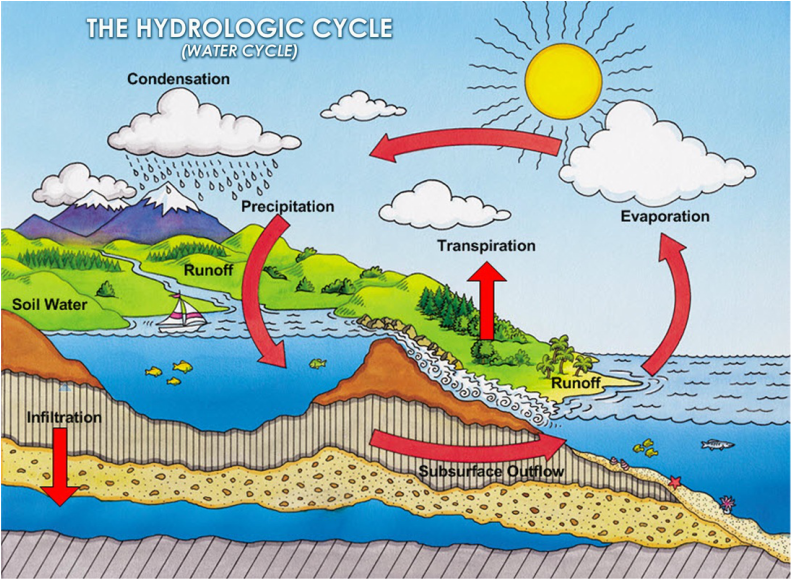
Water is most generally found in its liquid form, in rivers, oceans, streams, and in the earth. The sun’s rays constantly warm these water bodies and, whether through this heat or through man-made means, the water particles gain energy, transforming the water from liquid into vapor phase through evaporation. The water vapor hence becomes less dense and rises with the warm air into the sky where they adhere along with other water particles to form clouds.
Typically, we consider the boiling point of water to be a hundred degrees centigrade, which is certainly true when pressure and humidity are normal i.e 1 atmp. However, places such as mountains, where humidity is low and pressure is even lower, require less energy to vaporise the water molecules.
Steps of the Hydrologic Cycle
- Evaporation – It is the transition of liquid water into water vapour by consuming energy from the surroundings primarily from solar radiation and slightly contributed by other factors.
- Evapotranspiration – Transformation of liquid water to water vapour due to metabolism activities of plants. This makes up a large portion of the water in the planet’s atmosphere due to the sheer surface area of the globe covered by flora.
- Sublimation – At low pressure and humidity, ice and snow can directly change to water vapour known as sublimation. At low air pressure, less amount of energy is required to sublimate the ice into vapour. Other factors are high winds and strong sunlight, which is why mountain ice is a prime place for sublimation, while ground ice sublimation is not so common.
Further, as the air gets cooler at higher altitude. Water vapour cools significantly and clumps together to form the clouds. Clouds when subjected to the movement of the wind and the changes in the air pressure, leads to the downward movement of water.
- Precipitation/Rainfall – Water vapor condenses around particles and other matter that rises up with the water during evaporation, giving a nucleus to the water droplet so that it can clump together. Once a number of such tiny, particle-based droplets are formed, they collide and adds together to form larger droplets. After a certain time, the droplet will become big enough so that its mass will be subjected to the force of gravity at a rate faster than the force of the updraft in the air around it. At this point, the water falls back to earth and it is known as precipitation.
Forms of Precipitations

- Rain: Precipitation in the form of water droplets and ranging from the size of 0.5 to 6 mm in diameter.
- Snow: Precipitation in the form of water solid matter, where densities vary between 0.06 to 0.15 g/cm3.
- Drizzle: Precipitation in the form of water droplets of size less than 0.5 mm in diameter.
- Glaze: Rainfall or drizzle when comes in contact with the ground surface having a temperature less than 0°C then those water droplet will form a thin layer of ice above the ground surface.
- Sleet: Water molecule coming in contact with the solid particle present in air forms sleet.
- Hail: Precipitation in the form of water droplets of size more than 6 mm in diameter.
When water falls to earth then infiltration, surface runoff and evaporation mainly takes place.
- Infiltration – It is water that penetrates into the soil and other absorbent surfaces. The water moves throughout the soil, saturating it and joining groundwater stream.
- Groundwater Storage – It is water that has not precipitated or runoff into streams or rivers, but instead moves deep underground forming pools known as “groundwater storage”.
- Runoff – After heavy rainfall has saturated the soil it will cease to absorb water and additional rainfall, as well as melted snow and ice, will simply flow off of the surface. Thus excess rainfall over the surface is known as “runoff”, and it is the principle way in which water moves along the Earth’s surface.
- Stream-flow – It is the direction the runoff takes to form a stream and it is this flow which dictates the river’s currents depending on how close they are located to the ocean.
The hydrologic cycle happens continuously, with all different steps happening simultaneously all around the world.
 AN ENGINEERING BRAIN