

Concrete used in the construction is a composite mixture of fine and coarse aggregate which are bonded together with a fluid cement which hardens over time. The behavior of the fresh, as well as hardened concrete, depends upon numerous factors. Types of constituents added in the concrete, their quality and a proper their proportion of each with other are key factors which decide the strength, durability and even the mode of failures of concrete.
Concrete may fail in tension, compression, shear, bending or torsion. It may also be considered to be failed if excessive deflection, cracking or vibration is observed. Usually, the failure involved in the limit state of collapse can be neglected due to the high factor of safety considered during design. But the failures of limit state of serviceability are more prominent as it is often unpredictable.
However, the most common problem in concrete is the development of cracks. The cracks in the concrete making it vulnerable impairs the durability of concrete as they provide an easy path for the transportation of liquids and gasses that potentially contain harmful substances. Also, if these tiny cracks grow and reach the reinforcement, it may lead to the corrosion of the reinforcement as well. Reinforcements are necessary as they allow the concrete to bear tensile forces. Hence it is of utmost importance to control the crack width and heal the crack as soon as possible.
Cracks in the concrete may be due to the following reasons:
- Expansions or shrinkage due to temperature change
- Settlement of the structure
- Application of heavy load
- Loss of water due to surface shrinkage
- Insufficient compaction during concreting
- Insufficient cover provided to the member
- High water-cement ratio
- Corrosion of reinforcement steel
The task of repairing and maintenance of concrete is of high cost and is not something that could be done on a regular basis. The self-healing concrete concept is the perfect solution to all the problems as it has an ability to self heal its cracks. It is an economical and better solution as it not only results in the long service life of concrete structures but would also make the material more durable and sustainable.
There exist different types of healing mechanism which are as following: –
Autogenous Healing

In this mechanism, the concrete is healed via natural processes in the presence of moisture and the absence of tensile stress. Mechanical blocking by particles carried into the cracks along with the deposition of calcium carbonate from the cementitious material repairs the crack. As soon as the water comes in contact with the unhydrated cement particles, further hydration occurs. The dissolved carbon dioxide in water reacts the with Calcium Ca+2 ion to form calcium carbonate which seals up the crack. The drawback of this mechanism is that it may only be used for healing small cracks. This healing mechanism can be enhanced by adding microfibers to the mixture. Addition of these causes only small multiple cracks to occur which can be healed easily rather than causing one wide crack.
Superabsorbent Polymers (Sap)

Superabsorbent Polymers (SAP) or hydrogel take up a large amount of the fluid cement and retain it in their structure without getting dissolved. These SAPs get exposed to the humid environment when a crack occurs and this causes them to swell up. The swelling of SAPs partly seals the crack forbidding the intrusion of potentially harmful substances. Once swollen these SAP particles desorb and provide the fluid surrounding matrix for internal curing, followed by hydration and precipitation of calcium carbonate. Hence the crack gets closed completely.
Calcium Carbonate Precipitating Micro-Organism
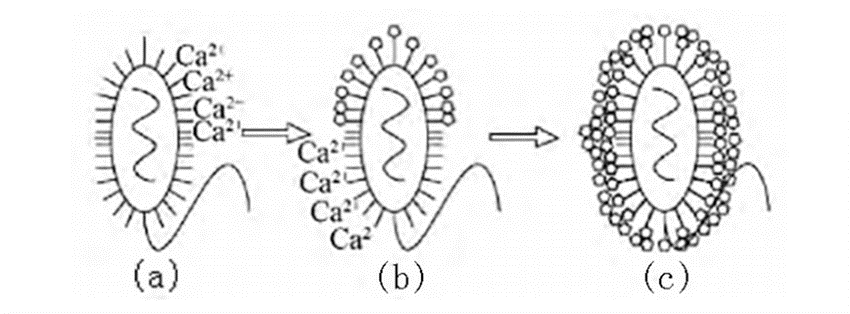
Another way of healing crack is by using calcium carbonate precipitating micro-organisms in the concrete matrix. Micro-organisms are embedded after immobilization on diatomaceous earth in microcapsules or in SAP and begin with the precipitation of calcium carbonate once a crack occurs. It is one of the eco-friendliest methods of healing concrete.
Encapsulated Polymers
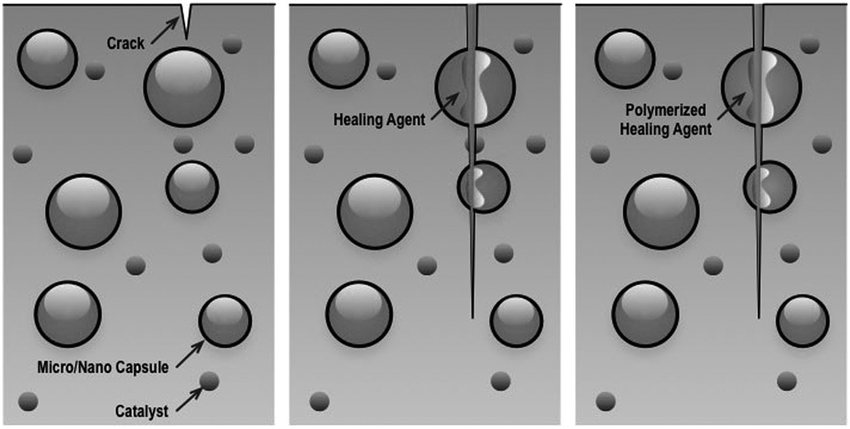
One of the other mechanisms considered by many research programs is the use of encapsulated polymers. When a crack is formed the capsules rupture and the precursors’ healing agent’s flow to fill the crack due to capillary action and subsequently cure to form a cohesive polymer bonding the opposite sides of the crack thus healing it. Healing agents which are encapsulated are chosen according to the required regain in properties. Polyurethane is provided inside these capsules to reduce water permeability of the cracked concrete. To regain strength, methyl methacrylate is encapsulated. For aesthetic aspect importance, water repellent agents can be encapsulated. Brittle glass or ceramic tubes are few of the examples used as encapsulating materials. Since the capsule has to survive the harsh mixing process in concrete, researches are still working on materials which can be chosen to make the capsules which could survive the mixing.
Alkali Activators

The self-healing capabilities of fly-ash and blast furnace slag concrete can be much higher just because of the low hydration degree of the slag and fly-ash particles. This compensates for their inferiority in early stage microstructure and strength development. As the crack occurs, the unreacted particles can be activated again due to the action of alkali activators, closing the crack and regaining water impermeability and strength. Different types of alkali-activators suited for this job are NaOH, KOH or silicate solution.
Test Comparison of Ordinary vs Self Healing Concrete
Here, we are comparing the test results of ordinary conventional concrete with Self-healing concrete based on bacterial mechanism
Comparison of the Split tensile strength of conventional concrete and bacterial concrete
| Sr No | No of days | Split Tensile Strength of conventional concrete | Split Tensile Strength of bacterial concrete |
| 1 | 3 | 3.78 | 4.30 |
| 2 | 7 | 4.62 | 5.28 |
| 3 | 28 | 4.85 | 5.74 |
Comparison of Compressive strength of conventional concrete and self-healing (bacterial) concrete
| Sr No | No of days | Compressive Strength of conventional concrete | Compressive Strength of bacterial concrete |
| 1 | 3 | 3.78 | 4.30 |
| 2 | 7 | 4.62 | 5.28 |
| 3 | 28 | 4.85 | 5.74 |
Stress-strain behavior comparison of conventional concrete and bacterial concrete
The Stress-Strain behavior of bacterial self-healing concrete of grade M60 as compared to Conventional concrete.
| Conventional | Concrete | Self-Healing | Concrete |
| Strain | Stress (Mpa) | Strain | Stress (MPa) |
| 0 | 0 | 0 | 0 |
| 0.0001 | 3.27 | 0.0001 | 2.83 |
| 0.0002 | 6.41 | 0.0001 | 5.66 |
| 0.0003 | 9.01 | 0.0002 | 8.49 |
| 0.0004 | 12.98 | 0.0003 | 11.32 |
| 0.0005 | 15.32 | 0.0003 | 14.15 |
| 0.0006 | 18.65 | 0.0004 | 16.99 |
| 0.0007 | 31.00 | 0.0004 | 19.62 |
| 0.0008 | 34.60 | 0.0005 | 23.20 |
| 0.0009 | 28.56 | 0.0006 | 25.70 |
| 0.0010 | 36.00 | 0.0007 | 31.00 |
Advantages of Self Healing Concrete
- Self-repairing of cracks without any external aide
- Self-healing concrete performs better than the ordinary concrete in terms of flexural, tensile and compressive strength
- Resistance against freezing and thawing due to temperature variations. Self-healing concrete is more impermeable than the ordinary one
- Increases durability and protection against the corrosion of reinforcement
Disadvantages of Bacterial Concrete
- Self-healing concrete is costlier
- The clay pellets, encapsulated polymer or sap holding the self-healing agent comprise 20% of the volume of the concrete which may become a shear zone or fault zone in the concrete.
- Design and Specifications related to Self Healing Concrete is not yet available in IS Code or other code
Conclusion
The introduction of this new technology will surely bring a revolution in the field of construction. It won’t only strengthen the concrete but would also help in cost reduction. This new technology will surely lead to the expansion and development of numerous innovative structures and help us realize the dream of Advance Construction Technology.
 AN ENGINEERING BRAIN